
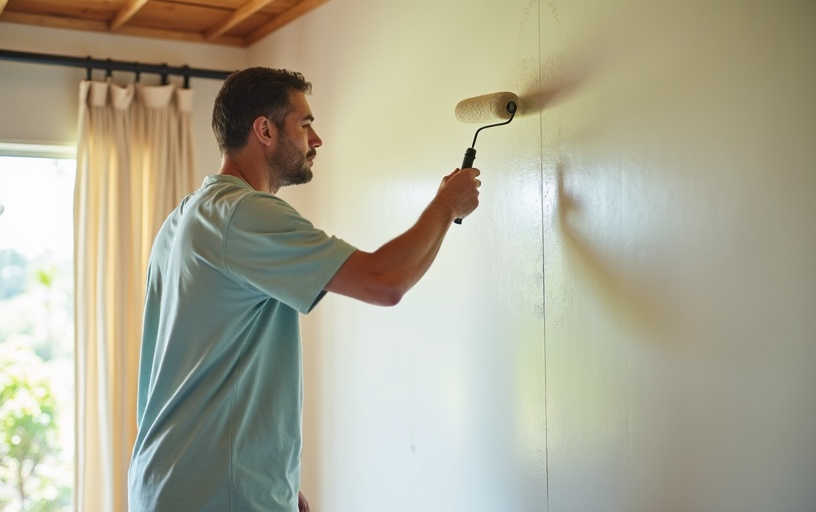
I'm a painting contractor, so you might expect me to say 'always hire a pro.' But that's not honest advice. There are situations where DIY makes total sense — and situations where it'll cost you more than hiring someone in the first place. Here's my real take after 30+ years on Oahu.
1When DIY Actually Makes Sense
A single interior room with no major prep issues is a reasonable DIY project. If the walls are in good shape, you're not dealing with mold or peeling paint, and you have a weekend to spare — go for it. Touch-up work, accent walls, and small spaces like closets or laundry rooms are also good candidates. The key is honest self-assessment: do you have the time, patience, and attention to detail to do it right? A rushed DIY job looks worse than a professional one and still costs you materials and a weekend.
2When You Should Definitely Hire a Pro
Exterior painting in Hawaii is almost always a job for a professional. The prep work alone — power washing, scraping, sanding, priming, caulking — requires equipment and experience that most homeowners don't have. Get it wrong and you're repainting in two years. Two-story or multi-story work is also a safety issue; ladder accidents are one of the most common home improvement injuries. Any job involving mold treatment, significant surface damage, or specialty surfaces (stucco, wood siding, metal) should go to someone who knows what they're doing.
3The Hidden Costs of DIY
People underestimate what a DIY paint job actually costs. Brushes, rollers, trays, tape, drop cloths, primer, two coats of paint, caulk, sandpaper — it adds up fast. For a whole room, you might spend $200–400 in materials alone. Add in your time — a weekend for a single room if you're not experienced — and the 'savings' shrink considerably. If you make a mistake that needs to be fixed by a professional later, you've paid twice.
4The Quality Gap Is Real
A professional painter with years of experience will produce a noticeably better result than most homeowners — cleaner lines, more even coverage, better color consistency. That gap is smaller on a simple interior room and much larger on complex exterior work or cabinets. If the space is somewhere you care about — your living room, your kitchen, your front exterior — the quality difference is worth paying for.
5A Practical Framework
Ask yourself three questions: Is this a safety risk (height, chemicals, mold)? Is this a high-visibility area where quality really matters? Does it require specialized prep or equipment? If the answer to any of these is yes, hire a professional. If it's a low-stakes interior space in good condition and you enjoy the work — DIY away. There's no shame in either choice.
If you do go DIY, don't skip the primer. It's the step most homeowners skip to save time, and it's the step that most affects how the final coat looks and how long it lasts.