
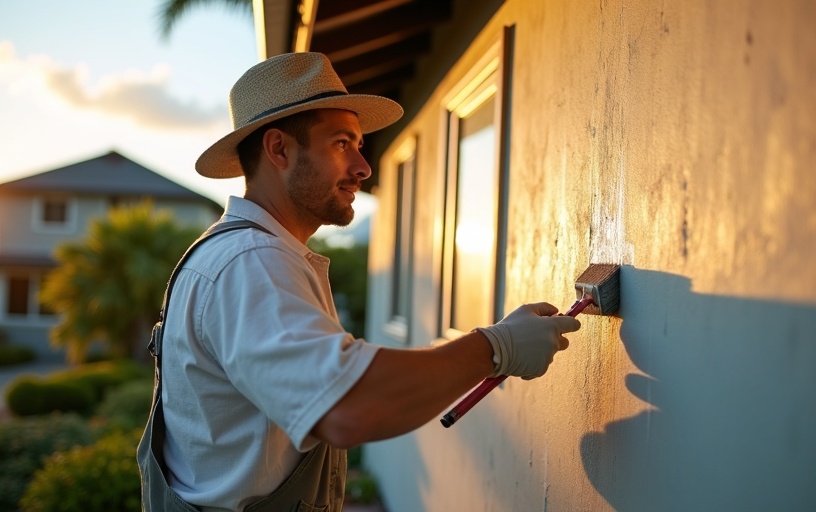
I've been painting homes on Oahu for over 30 years. In that time, I've re-done a lot of jobs that someone else did first. The homeowner saved $800 on the original quote. Then spent $3,000 fixing it two years later. I'm not writing this to sell you on hiring me specifically — I'm writing it because I've watched this play out hundreds of times and it genuinely frustrates me. Here's what's actually happening when a bid comes in suspiciously low.
1Low Bids Are Usually Bought With Skipped Prep
Prep work — power washing, scraping, sanding, priming, caulking — is the most time-consuming part of any paint job. It's also the part that determines how long the result lasts. When a painter bids $1,500 for a job that should cost $3,500, something has to give. Nine times out of ten, it's the prep. They roll paint over dirty, chalking, or peeling surfaces. It looks fine on day one. By year two, it's peeling in sheets. In Hawaii's climate, skipped prep doesn't just shorten the lifespan — it accelerates failure dramatically.
2Cheap Paint Is a False Economy
There's a real cost difference between builder-grade paint and a premium product like Sherwin-Williams Duration. On a whole house exterior, that difference might be $400–600 in materials. A low-bid painter often absorbs that gap by using cheaper paint — sometimes without telling you. The result looks identical on day one. But Hawaii's UV, salt air, and humidity will expose the difference within 18–24 months. You'll be repainting years sooner. The $500 you saved on the original job costs you a full repaint ahead of schedule.
3Unlicensed and Uninsured Is a Real Risk
In Hawaii, painting contractors are required to be licensed and carry general liability and workers' compensation insurance. A low bid often means one or both are missing. If a worker gets hurt on your property and there's no workers' comp, you can be held liable. If something gets damaged — a window, a floor, a piece of furniture — and there's no liability insurance, you're on your own. The savings on the bid can disappear instantly in a single incident. Always ask for proof of license and insurance before anyone starts work.
4The Hidden Cost of Doing It Twice
Here's the math nobody talks about: if a quality paint job costs $4,000 and lasts 8–10 years, that's $400–500 per year. If a cheap paint job costs $2,000 but fails in 3 years, that's $667 per year — and you're back to square one, paying again, with a surface that's now in worse shape than before. In Hawaii especially, where moisture damage compounds fast, a failed paint job isn't just cosmetic. Water getting behind peeling paint can rot wood, damage stucco, and create mold problems that cost far more than any paint job to fix.
5What to Look for in a Legitimate Quote
A real quote should specify what prep work is included, what paint product will be used (brand and product line), how many coats, and what's covered if something goes wrong. If a quote is vague — just a number with no detail — that's a red flag. Ask questions. A contractor who can't explain what they're doing and why isn't someone you want working on your home. And always get at least three quotes. Not to find the cheapest — to understand what a fair price actually looks like for your specific job.
Ask every painter you're considering: 'What prep work is included in this quote?' The answer tells you everything. A quality contractor will walk you through it in detail. A corner-cutter will give you a vague answer or change the subject.